What we have no concept for, we struggle to see. Perhaps the most compelling example of this lies in the color blue, or its absence from historical literature.
In Homer's Greece, the sea was "wine-dark"—never blue. The Hebrew Bible, ancient Chinese texts, Japanese, Icelandic sagas: no blue. Linguists later discovered that blue was the last color named in nearly every ancient language. A 2011 study of Namibia's Himba tribe—whose language groups blue and green together—found they couldn't easily spot a blue square among green ones, yet instantly detected shades of green that English speakers would miss entirely.
It wasn't because our ancients were colorblind, but because without a word, without it being categorized as distinct, we simply don't notice, even if the truth is all over our skies.
For most of medical history, anatomists looked at the human body with the same blindness: they saw muscles, bones, organs—the things they had names for. The connective tissue surrounding everything, however, was scraped away and ignored. Just as the Greeks could see the sea but not its blueness, surgeons could see fascia but not see it—until a handful of researchers in the 1970s began asking: what if the packing material is the point?
STRUCTURAL INTEGRATION
Enter Ida Rolf, who didn't wait for permission from the medical establishment to see that which was hidden in plain sight. A biochemist with a PhD from Columbia, she spent decades developing a hands-on technique she called Structural Integration. Her premise was radical for its time: the body's fascia—the continuous web of connective tissue surrounding every muscle, bone, and organ—wasn't just structural scaffolding. It was a living system that could be worked with, changed, and healed.
"It's all connected through the fascia," she insisted, long before science could prove her right.
Her students, notably Thomas Myers, carried this understanding into anatomy labs and clinics around the world.
In the 1960s, architect and structural engineer Buckminster Fuller coined the term tensegrity—a portmanteau of "tensional integrity." He was describing structures that maintain their shape through a balance of tension and compression: continuous tension with isolated compression elements.
Then, in 2007, Robert Schleip, a Rolfing instructor turned laboratory researcher, helped organize the first International Fascia Research Congress at Harvard Medical School. Funded by the National Institutes of Health, it brought together scientists, clinicians, and bodyworkers to examine the evidence.
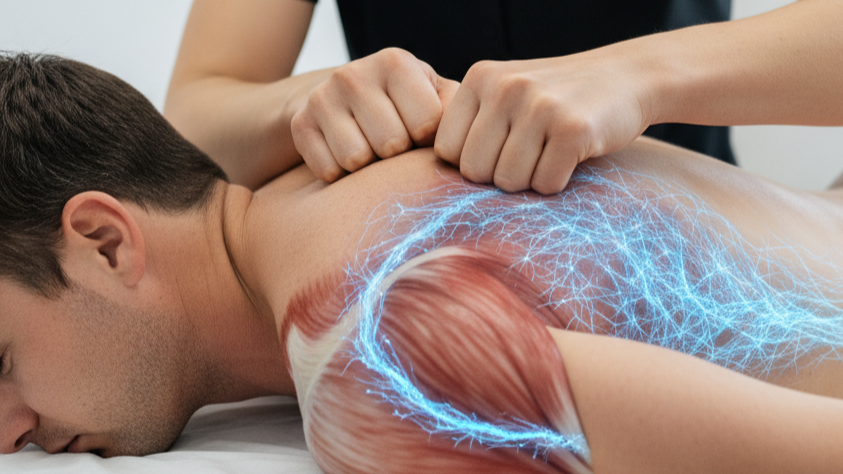
The findings were striking. Fascia wasn't passive tissue—it contained contractile cells that could actively tighten and release. It was richly innervated with sensory receptors, making it arguably the body's largest sensory organ. And crucially, it responded to sustained pressure and slow stretching in ways that muscle tissue alone could not.
Science Magazine covered the congress in a two-page spread titled "Cell Biology Meets Rolfing." The field had arrived.
Your Body as Architecture
Your skeleton doesn't stack like a building, bone upon bone. Instead, your bones float in a sea of soft tissue—muscles, tendons, ligaments, and fascia creating continuous tension while bones provide compression. This is why you can move fluidly in any direction, why strain in one area distributes throughout the whole system, and why pain can be referred: Your low back pain might be sourced in your foot. Your shoulder tension might originate in your hip.
And different from muscles which benefit from shorter intense stretches, this tissue doesn't respond to quick stretches. It needs time, patience, and consistent gentle pressure.
What This Means for You
Understanding fascia changes how we approach our body:
Pain travels. That chronic ache might not originate where you feel it. The fascial web distributes strain throughout the system.
Slow works. Quick stretches change muscle length. Sustained pressure changes fascial structure. Both matter, but they're different tools.
Connection is real. The intuition that "everything is connected" isn't just spiritual poetry—it's anatomical fact.
Your body responds. Fascia is living tissue that remodels based on how you use it. Consistent practice creates lasting change.
A Tennis Ball and Thirty Seconds
You can start working with your fascia today with nothing more than a tennis ball.
Self-myofascial release (SMR) works by applying sustained pressure to trigger points—those anchored, tender spots where fascia has become stuck. The pressure helps break down adhesions and restore the tissue to a more fluid state.
Research supports it: a randomized controlled trial found that tennis ball myofascial release combined with stretching was significantly more effective than stretching alone. The key is sustained pressure—30 to 60 seconds minimum, up to 3-5 minutes for stubborn areas.
A few principles:
Find a tender spot, then stay there (don't roll frantically)
Breathe and let the tissue soften
Work a few areas at a time, starting with the worst spots
Move and stretch afterward
That's it. A tennis ball and body awareness. Simple tools, profound effects.
Going Deeper
If this resonates, there's more to explore.
We're hosting a Myofascial Trigger Point Release Workshop on Saturday, February 21st, 10-12pm at Anchorpoint with teachers Kimberlyn and Dina—both experienced in these techniques. Two hours of learning to find and release your own trigger points in the neck, shoulders, back, and hips.
No prior experience needed. Just curiosity about this hidden web that's been holding you together all along. Signup Here.