We don't suffer from the world as it is. We suffer from the world as we mis-see it.
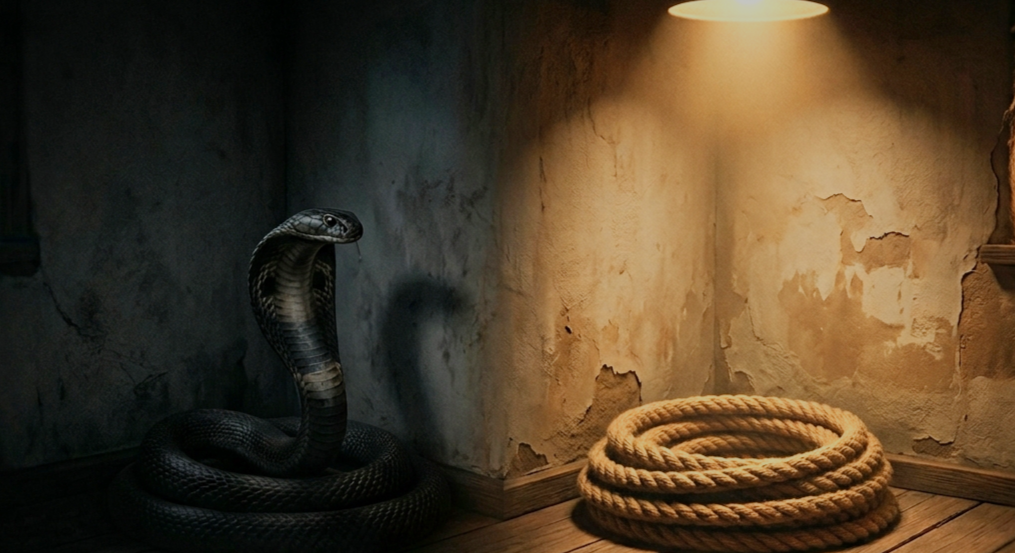
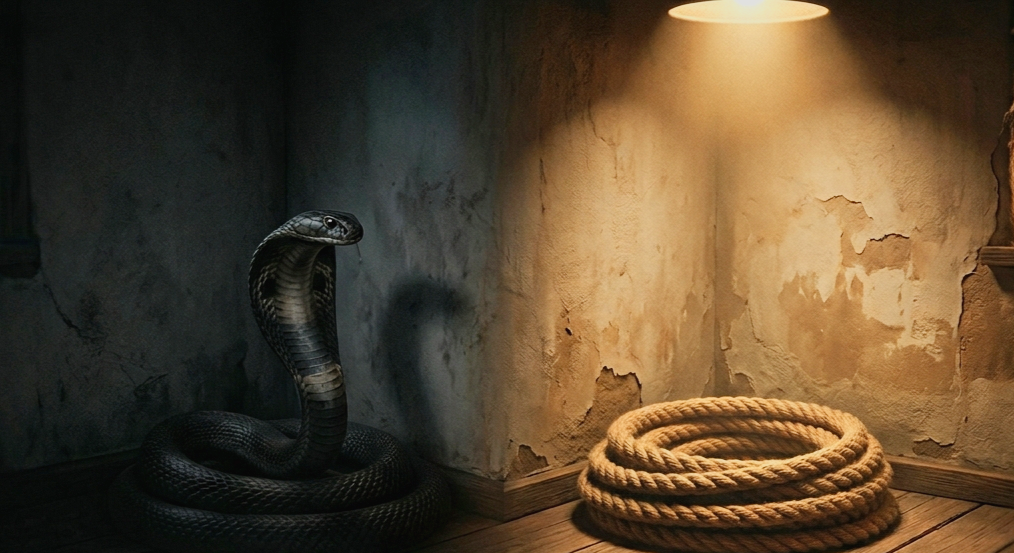
You walk into a dim room and freeze. There's a snake coiled in the corner. Your heart slams, your breath catches, your body floods with the chemistry of fear. Then the lights come on, and…
…it's just a harmless coil of rope.
Now you're in relief. You're even giggling at the ridiculousness, the memory of your terror fading like a dream, because now you see it for what it really is.
TALE AS OLD AS TIME
This is the Rajju Sarpa Nyāya, the Snake and the Rope Analogy. Its earliest recorded version originated in ancient Greece under Carneades (214–129 BCE) of the Academic Skeptic School. Centuries later it emerged in Indian philosophy via the Mahāyāna Buddhist thinker Āryadeva (c. 200–300 CE) to illustrate mental projection, before becoming a cornerstone of Advaita Vedānta via Gauḍapāda, pointing at the deepest misperception of all: mistaking the apparent for the real, the passing for the permanent.
Across every one of these traditions, the diagnosis is identical. Un-needed suffering arises not from the world as it is, but from the world as we mis-see it. Darkness, in every school, is a word for ignorance. Not moral failure, but a cloudedness of perception. And light is the moment that cloudedness lifts.
The trick of the analogy
Here is what makes this image quietly clever. It seems to be about what you see. Snake becomes rope, problem solved. But in that shift, nothing outside actually changed. The only thing that shifted was something inside the one looking. The rope was always the rope.
Which means the light in this story was never a switch on the wall. It was always about the perceiver. When we say the light came on, we mean something woke up inside. A small step back. A moment of not being completely inside the fear. Enough distance to see that the seeing itself had been coloured by old memories of the past, by half-formed worries of an uncertain future, by a mind too full of elsewhere to meet what was actually here.
That's the inward turn the analogy is really pointing to. Not "look at the rope more carefully." But "notice who has been looking." That relief, the laughter where moments ago there was terror, doesn't need to wait for someone else to flick the switch. You can turn it on yourself.
A room full of snakes
We are now thousands of years past the first mention of this analogy, and we are still every bit as susceptible to it. We have collectively convinced ourselves that we live in a room full of snakes. Every notification, every headline, every unfinished conversation and unpaid bill is another coil in another dark corner, and they are made of the same stuff as the original: memory and anticipation.
The body, however, does not know the difference. The sympathetic nervous system, designed for the occasional genuine snake, now runs more or less continuously, flooding us with the chemistry of threat from morning to night. We have made the alarm permanent. The bill arrives as chronic stress, disrupted sleep, inflammation, and the creeping metabolic disorders that have quietly become the signature of modern life. Not because the world is unbearable, but because we have stopped checking whether the snake is actually a snake.
Now Switch the Light On
invite yourself, now, to take a step back to simply follow your breath.
Let the breath be noticed rather than controlled. Turn the attention around - from the breathing, to the one who is breathing. Let that one grow a little quieter so that the actual texture of this moment can come forward.
Let this lead you to your first honest glimpse of what you are: not one more thing in the room, but the light by which the room is seen.
Want to go deeper?
These ideas are also in the living heart of Patañjali's Yoga Sūtras: one of the most precise and practical maps of consciousness ever written. If this piece opened something for you, the Yoga Sūtras course at NPSOY will take you further into the impurities that keep us in the dark, and the discernment that allows us to surrender to the truth of our existence.
References
“For example, on seeing a coil of rope in an unlighted room a man jumps over it, conceiving it for the moment to be a snake, but turning back afterwards he inquires into the truth, and on finding it motionless he is already inclined to think that it is not a snake, but as he reckons, all the same, that snakes too are motionless at times when numbed by winter’s frost, he prods at the coiled mass with a stick, and then, after thus testing the impressions received, he assents to the fact that it is false to suppose that the body presented to him is a snake”” (Sextus Empiricus, Against the Logicians I.184).
Aryadeva, The Four Hundred Stanzas on the Middle Way (Sanskrit: Catuḥśataka, Chapter 8, Verse 178 / Verse 3).
Gaudapada, The Mandukya Karika (Chapter 2: Vaitathya Prakarana, Verses 17–18).