Pain under the sit bones is common enough in yoga that it has a nickname: yoga butt. Clinically, proximal hamstring tendinopathy: an irritated tendon where the hamstrings anchor to the sit bone.
The folklore blames overstretching. That needs to be examined.
What's actually happening
Fold deep into a forward bend and the hamstring tendon gets pressed against the bony point of your sit bone. Bone on tendon. That compression is the current leading explanation in the clinical literature (Goom et al., 2016).
Compression alone, however, doesn't usually break a tendon. A strong tendon absorbs it.
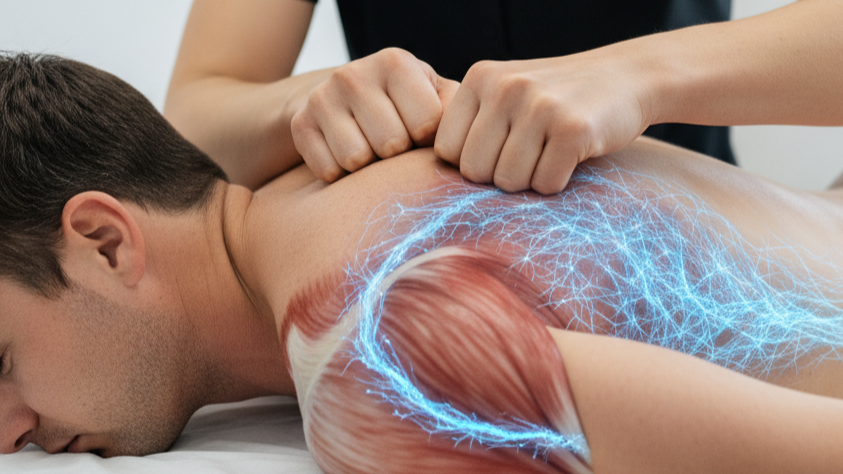
Tendons are ropes transmitting muscle force to bone. They thicken and toughen when muscles pull on them hard, and nothing else does it. The biomechanist Jules Mitchell puts it plainly: tendons need to be loaded.
Yoga has no shortage of healthy hamstring loads in eccentric and isometric engagements.
That’s not to say, though, that the Yin Yoga of passive lengthening has no place — long quiet holds are a real stimulus to connective tissue.
The trouble comes from an imbalanced practice built almost entirely from one of them. When every hamstring pose is met with release, soften, let go and none with press, meet, resist, the tendon gets compressed regularly and worked rarely.
Yoga butt is an underloading injury with a compression problem on top.
The pose you already have
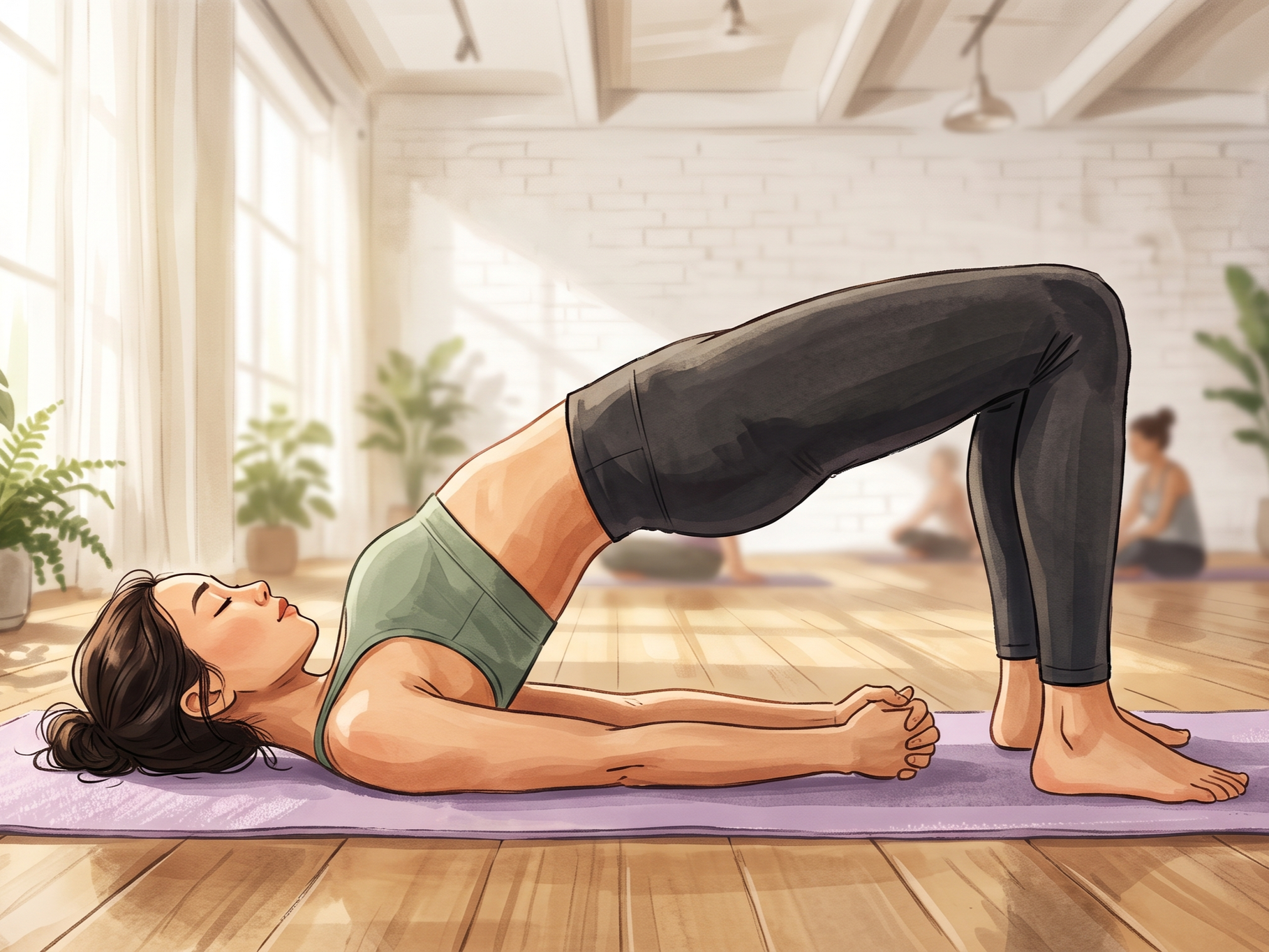
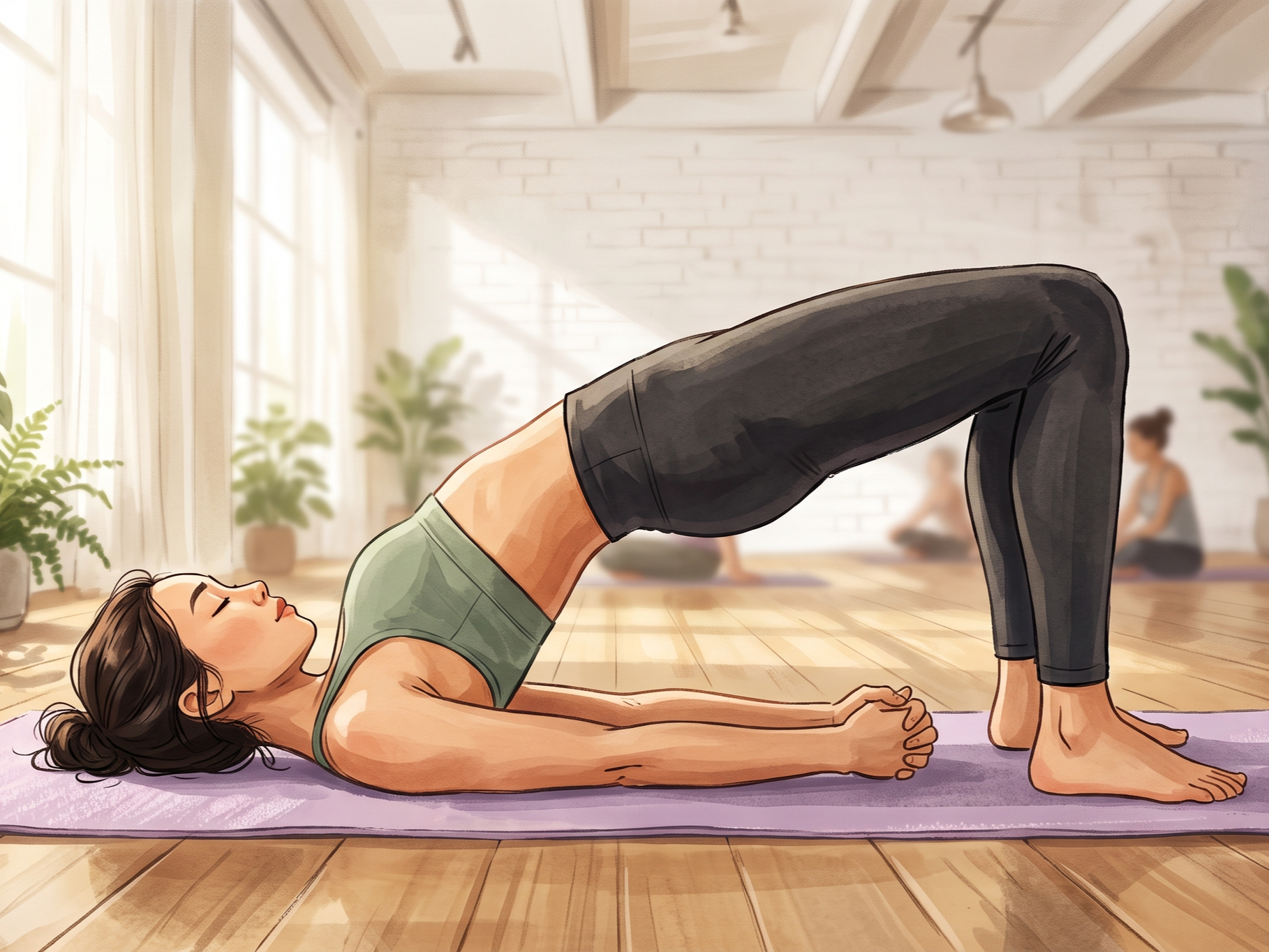
To rehabilitate, you need to load that tendon somewhere it isn't being squeezed. Bridge Pose (Setu Bandha Sarvangasana) is the one position that does both.
The hips are extended so the tendon isn't pressed against the sit bone at all. And the hamstrings must work to hold you up. Compression, gone. Load, delivered.
Bridge is normally practised for the chest and the glutes. For the pose to target the hamstrings enough to strengthen the tendon, though, it needs a different emphasis than usual:
Lie on your back, knees bent, feet flat and hip-width. Before you lift, put your attention in the back of the thighs. Now press down through the heels — as though trying to drag them toward your hips through the floor — and let that pressing be what raises you. The chest still opens. But only after the hamstrings are targeted.
The dose. Hold 45 seconds. Five rounds.
Progressing. When five rounds are easy, try these following variations:
Long Bridge: walk the feet further from the hips. Longer lever, harder work.
One Legged Bridge: While maintaining the pose carefully exhale to tuck one knee towards your chest, optionally extending the tucked leg towards the ceiling.
Slippery Bridge: slide the feet slowly out and back on sliders or wearing socks, or a blanket.
Judging it. A tendon tells the truth the next morning, not during. Worse tomorrow means too much. Same or better means you found the dose.
Then let the forward bends come back. As the tendon strengthens, depth returns. It just isn't the first step.
Connective tissue takes months, sometimes a couple of years, to remodel. Work with the body, not against. Take time, give space.
Joy in the Body: Hips
If this landed, I’m conducting a two part, three weekend exploration of the healthy movement of the Hips, pelvis, knees and ankles. We’ll be exploring how to make the poses work for the functional benefits of your body for a sustainable practice. You’ll benefit if you’re a student or a teacher. More info below:
Module 1 → https://clients.oclass.app/priyan-yoga/book/course/61157
Module 2 → https://clients.oclass.app/priyan-yoga/book/course/61158
Sources
Goom TSH, Malliaras P, Reiman MP, Purdam CR (2016). Proximal Hamstring Tendinopathy: Clinical Aspects of Assessment and Management. JOSPT 46(6):483-493.
https://www.jospt.org/doi/10.2519/jospt.2016.5986Cook JL, Purdam CR (2012). Is compressive load a factor in the development of tendinopathy? BJSM 46(3):163-168.
https://pubmed.ncbi.nlm.nih.gov/22113234/Mitchell J (2016). Proximal Hamstring Tendinopathy. julesmitchell.com
https://www.julesmitchell.com/proximal-hamstring-tendinopathy-aka-nagging-pain-back-thigh-meets-butt/